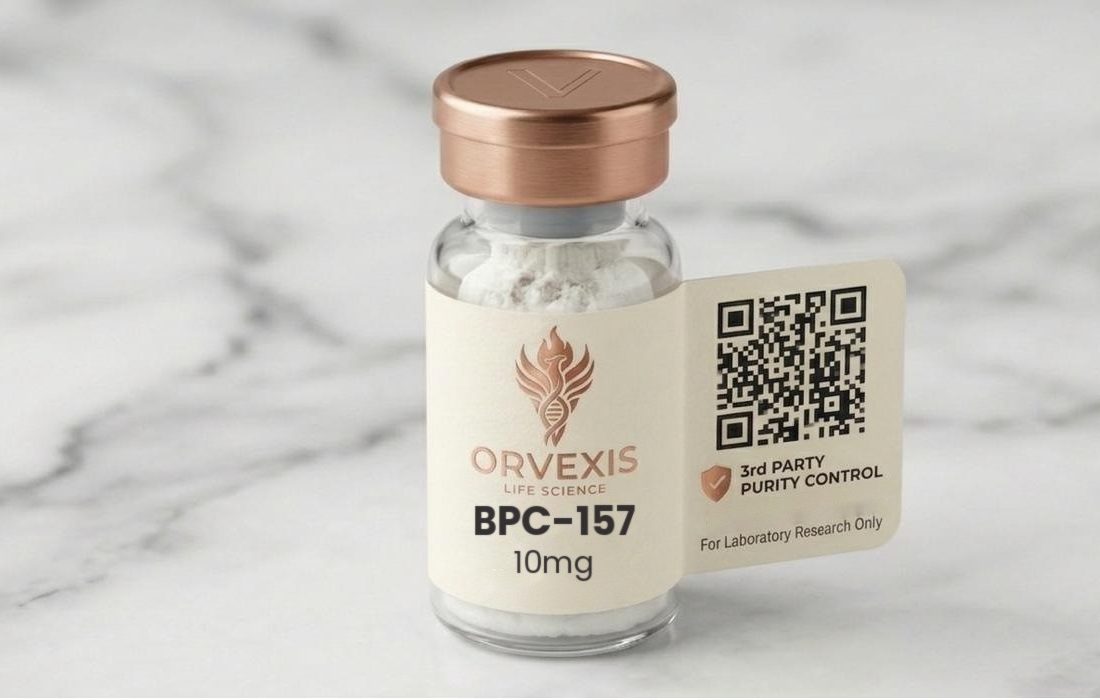
Every vial carries this batch's QR. It opens the lab's own report on the lab's servers, verify this batch yourself, no account needed.
Showing the three most recent. Every earlier batch keeps its own report page, so a vial bought months ago can still be checked. See all batches of this product →
BPC-157
10 mg lyophilized powder in a sealed glass vial. Studied in preclinical research on tissue repair and the gut–brain axis.
- EU warehouseno customs, tracked to your door
- Card paymentregistered seller · company details
- Sequence
- Gly-Glu-Pro-Pro-Pro-Gly-Lys-Pro-Ala-Asp-Asp-Ala-Gly-Leu-Val
- CAS number
- 137525-51-0
- Molecular weight
- 1419.5 g/mol
- Counter-ion
- Stated on the certificate of analysis
- Contents
- BPC-157 · 10 mg per vial
- Form
- Lyophilized powder, sealed under inert gas
- Storage
- 2–8 °C sealed, protected from light
- Documentation
- Certificate of Analysis per batch, linked via QR
- Delivery
- Ships from our warehouse in Poland within 1–3 working days, tracked, no customs within the EU. Typically 3–5 working days; shipping €9.00, free from €150.
What BPC-157 is
BPC-157 (Body Protection Compound-157) is a synthetic peptide of 15 amino acids. Its sequence is a fragment of a larger protective protein first isolated from human gastric juice. It is water-soluble, stable in the acidic conditions of the stomach in laboratory models, and supplied here as a lyophilized (freeze-dried) powder for laboratory research.
What the research examines
Tissue repair. The largest body of preclinical work studies BPC-157 in animal models of tendon, ligament, muscle and bone injury, examining healing rates and collagen organisation.
The gastrointestinal tract. Its origin as a gastric fragment led to studies in models of gut lesions and inflammatory conditions of the intestine.
Blood vessels. Several studies investigate angiogenesis and the compound's interaction with the nitric-oxide system in vascular models.
The gut–brain axis. More recent preclinical work looks at interactions between the gut and the central nervous system.
Nearly all published work is preclinical, cell cultures and animal models. BPC-157 is not an approved medicine anywhere, and this page makes no claims about effects in humans.
Selected literature
- Sikiric P, et al. Current Pharmaceutical Design, 2018, review of stable gastric pentadecapeptide research.
- Vukojević J, et al. Pharmaceuticals, 2022, overview of preclinical findings on BPC-157 and the vascular system.
- Chang C-H, et al. Journal of Applied Physiology, 2011, tendon fibroblast studies.
- Seiwerth S, et al. Current Neuropharmacology, 2021, review of gut–brain axis findings.
Full citation list with DOI links in the research library.
New to research peptides?
What is a research peptide?
A short chain of amino acids produced synthetically for laboratory investigation. Research peptides are sold as chemical reagents to study biological mechanisms; they are not medicines, foods or supplements and are not for human use.
What does "lyophilized" mean?
Freeze-dried. The peptide is supplied as a dry powder, which keeps it stable in storage. It is dissolved in the laboratory before use in an experiment.
How do I verify a batch?
Scan the QR on the vial, or open "Verify a batch" and enter the batch number. The report opens on the independent laboratory's own website, we cannot edit it.
What does the purity figure mean?
The share of the vial's peptide content that is the intended sequence, measured by HPLC. Identity is confirmed separately by mass spectrometry, so both "what" and "how pure" are tested.
How should it be stored?
Sealed vials at 2–8 °C, protected from light. Our storage guide covers handling of opened vials.