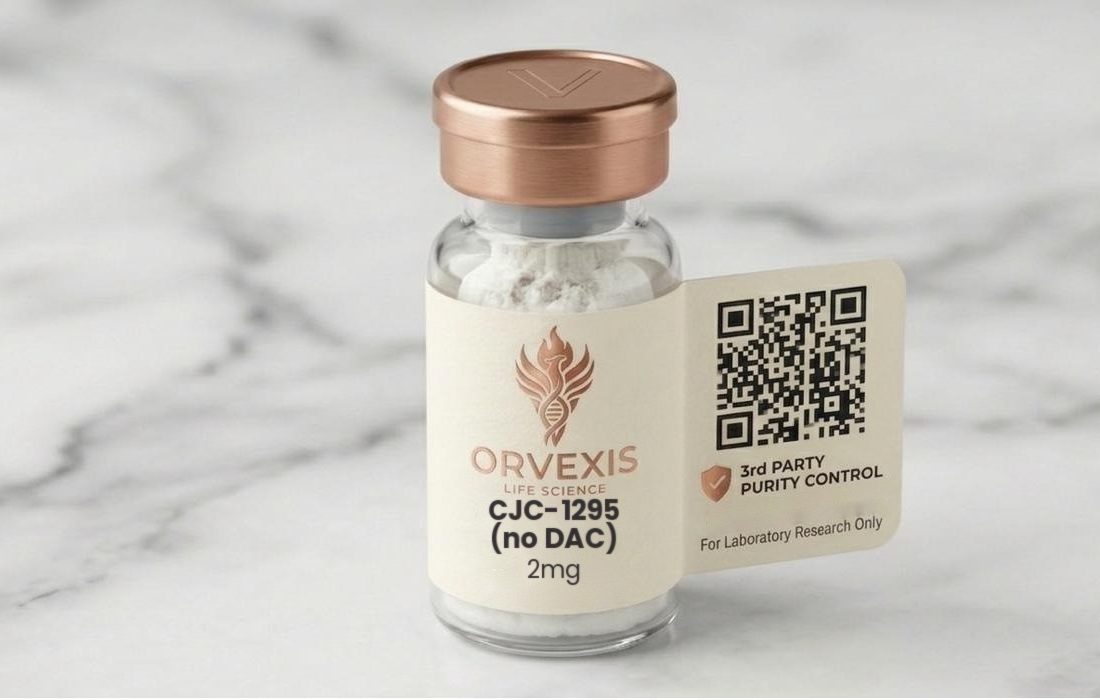
Every vial carries this batch's QR. It opens the lab's own report on the lab's servers, verify this batch yourself, no account needed.
Showing the three most recent. Every earlier batch keeps its own report page, so a vial bought months ago can still be checked. See all batches of this product →
CJC-1295 (no DAC)
2 mg lyophilized powder in a sealed glass vial.
- EU warehouseno customs, tracked to your door
- Card paymentregistered seller · company details
- Sequence
- Tyr-D-Ala-Asp-Ala-Ile-Phe-Thr-Gln-Ser-Tyr-Arg-Lys-Val-Leu-Ala-Gln-Leu-Ser-Ala-Arg-Lys-Leu-Leu-Gln-Asp-Ile-Leu-Ser-Arg-NH2
- CAS number
- Not assigned
- Molecular weight
- 3367.9 g/mol
- Counter-ion
- Stated on the certificate of analysis
- Contents
- CJC-1295 (no DAC) · 2 mg per vial
- Form
- Lyophilized powder, sealed under inert gas
- Storage
- 2–8 °C sealed, protected from light
- Documentation
- Certificate of Analysis per batch, linked via QR
- Delivery
- Ships from our warehouse in Poland within 1–3 working days, tracked, no customs within the EU. Typically 3–5 working days; shipping €9.00, free from €150.
What CJC-1295 (no DAC) is
CJC-1295 (no DAC), also called Modified GRF (1-29) or tetrasubstituted GRF(1-29), is a synthetic peptide amide of 29 amino acids based on the N-terminal 1–29 fragment of human growth-hormone-releasing hormone (GHRH), the shortest fragment that retains the full activity of the 44-residue hormone. Four residues are substituted, D-Ala2, Gln8, Ala15 and Leu27, to slow cleavage by dipeptidyl-peptidase IV and other plasma enzymes. It is the unconjugated core of CJC-1295, in which an additional lysine carrying a maleimidopropionyl group, the 'drug affinity complex' (DAC), binds the peptide to serum albumin; the no-DAC form lacks that linker. It is supplied here as a lyophilized (freeze-dried) powder for laboratory research.
What the research examines
Receptor activity and stability. The 2005 study that introduced the tetrasubstituted GRF(1-29) sequence synthesised maleimido derivatives of GRF(1-29), conjugated them to serum albumin, and compared them with native GRF(1-29) in dipeptidyl-peptidase IV stability assays, in a growth hormone secretion assay in cultured rat anterior pituitary cells and in growth hormone release in rats. The tetrasubstituted derivative carrying a C-terminal maleimidopropionyl-lysine was selected as CJC-1295 and its persistence in rat plasma was measured.
Enzymatic degradation of GHRH. Earlier work incubated native GHRH in human plasma and characterised its breakdown: dipeptidyl-peptidase IV removed the N-terminal dipeptide to give the largely inactive GHRH(3-44) fragment, and trypsin-like enzymes cleaved at basic residues. This degradation pattern is the rationale for the D-Ala2 substitution and the other changes in the modified peptide.
Growth hormone in humans. Two randomised, placebo-controlled, double-blind trials of 28 and 49 days in healthy adults aged 21 to 61 measured peak and cumulative plasma growth hormone and IGF-1 after the albumin-conjugated CJC-1295 and reported elevations lasting days to weeks. A separate study in healthy men aged 20 to 40 sampled blood every 20 minutes overnight to examine whether pulsatile growth hormone secretion persisted during continuous stimulation. Both concern the DAC-conjugated form.
Growth in GHRH-deficient mice. In mice with a targeted deletion of the GHRH gene, a five-week course of the conjugate from one week of age was compared with placebo-treated knockouts and heterozygous controls by body weight and length, femur and tibia length, body composition, pituitary RNA and growth hormone mRNA, and somatotroph immunohistochemistry, examining whether the growth deficit of the knockout was corrected. This work also used the DAC-conjugated form.
Published work on the tetrasubstituted peptide itself is limited to the 2005 study that introduced it; human trials concern the albumin-binding CJC-1295 conjugate. Other GHRH analogues have been approved as medicines (sermorelin, Geref, 1990 and 1997, discontinued 2008; tesamorelin, Egrifta, 2010), and CJC-1295 is named on the WADA prohibited list. CJC-1295 (no DAC) is not an approved medicine, and this page makes no claims about effects in humans.
Selected literature
- Jetté L, et al. Endocrinology, 2005, primary study introducing the tetrasubstituted peptide and its albumin conjugate; in vitro and rats. doi:10.1210/en.2004-1286
- Frohman LA, et al. Journal of Clinical Investigation, 1989, in vitro plasma degradation study of native GHRH. doi:10.1172/JCI114049
- Teichman SL, et al. The Journal of Clinical Endocrinology & Metabolism, 2006, randomised placebo-controlled trials in healthy adults; DAC-conjugated form. doi:10.1210/jc.2005-1536
- Ionescu M, Frohman LA. The Journal of Clinical Endocrinology & Metabolism, 2006, human physiology study; DAC-conjugated form. doi:10.1210/jc.2006-1702
- Alba M, et al. American Journal of Physiology-Endocrinology and Metabolism, 2006, GHRH knockout mouse; DAC-conjugated form. doi:10.1152/ajpendo.00201.2006
Every reference is listed with its DOI in the research library.
Handling in the laboratory
Store sealed at 2–8 °C for routine use or frozen for long-term storage, protected from light and moisture. Let the vial reach room temperature before opening. See Storage and handling of lyophilized research peptides.
New to research peptides?
What is a research peptide?
A short chain of amino acids produced synthetically for laboratory investigation. Research peptides are sold as chemical reagents to study biological mechanisms; they are not medicines, foods or supplements and are not for human use.
What does "lyophilized" mean?
Freeze-dried. The peptide is supplied as a dry powder, which keeps it stable in storage. It is dissolved in the laboratory before use in an experiment.
How do I verify a batch?
Scan the QR on the vial, or open "Verify a batch" and enter the batch number. The report opens on the independent laboratory's own website, we cannot edit it.
What does the purity figure mean?
The share of the vial's peptide content that is the intended sequence, measured by HPLC. Identity is confirmed separately by mass spectrometry, so both "what" and "how pure" are tested.
How should it be stored?
Sealed vials at 2–8 °C, protected from light. Our storage guide covers handling of opened vials.