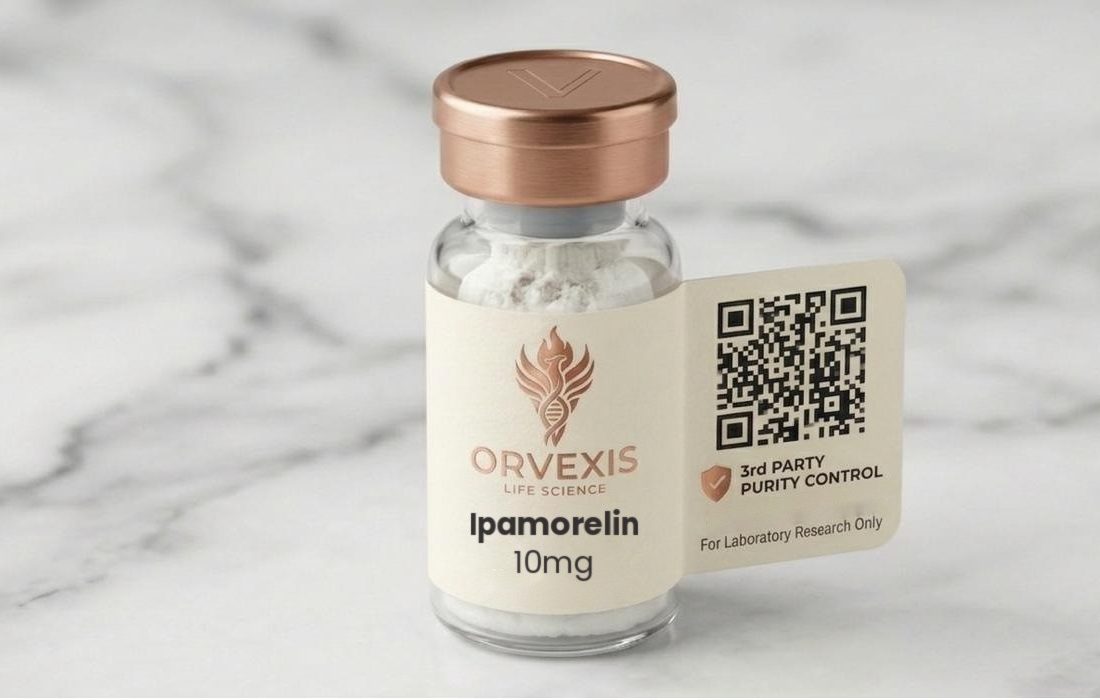
Every vial carries this batch's QR. It opens the lab's own report on the lab's servers, verify this batch yourself, no account needed.
Showing the three most recent. Every earlier batch keeps its own report page, so a vial bought months ago can still be checked. See all batches of this product →
Ipamorelin
10 mg lyophilized powder in a sealed glass vial.
- EU warehouseno customs, tracked to your door
- Card paymentregistered seller · company details
- Sequence
- Aib-His-D-2-Nal-D-Phe-Lys-NH2
- CAS number
- 170851-70-4
- Molecular weight
- 711.9 g/mol
- Counter-ion
- Stated on the certificate of analysis
- Contents
- Ipamorelin · 10 mg per vial
- Form
- Lyophilized powder, sealed under inert gas
- Storage
- 2–8 °C sealed, protected from light
- Documentation
- Certificate of Analysis per batch, linked via QR
- Delivery
- Ships from our warehouse in Poland within 1–3 working days, tracked, no customs within the EU. Typically 3–5 working days; shipping €9.00, free from €150.
What Ipamorelin is
Ipamorelin is a synthetic pentapeptide, five amino acids, developed at Novo Nordisk in the 1990s under the code NNC 26-0161. It belongs to the growth hormone secretagogue class of ghrelin-receptor agonists and contains three non-natural residues: aminoisobutyric acid, D-2-naphthylalanine and D-phenylalanine. The 1998 paper that introduced it described it as the first member of the class to release growth hormone in rats and swine without a measurable rise in ACTH, cortisol or prolactin, which is the origin of the word 'selective' in the title of that paper. It is supplied here as a lyophilized (freeze-dried) powder for laboratory research.
What the research examines
Growth hormone release. The 1998 characterisation study measured growth hormone release from cultured rat pituitary cells and in anaesthetised rats and conscious swine, comparing ipamorelin with GHRP-6 and GHRP-2, and reported growth hormone release without a measurable rise in ACTH, cortisol or prolactin. A randomised, placebo-controlled study in 48 healthy men modelled the relationship between plasma ipamorelin concentration and growth hormone response over time.
Bone growth. Rat studies examined longitudinal bone growth in young female animals, comparing ipamorelin with growth hormone; bone mineral content in adult female rats, compared with GHRP-6; and bone formation in adult rats treated with glucocorticoids, using bone histomorphometry.
Gastrointestinal motility. Because ghrelin-receptor agonists have been studied for effects on gut motility, a rat model of postoperative ileus measured gastric emptying, faecal pellet output and colonic contractility after ipamorelin. A subsequent multicentre, randomised, double-blind, placebo-controlled phase 2 trial in 114 people after bowel resection measured time to tolerance of a standardised solid meal; the difference from placebo was not statistically significant.
Published work consists of 1990s preclinical pharmacology and pharmacokinetic studies and a phase 2 programme in postoperative ileus (Helsinn Therapeutics) discontinued after the 2014 trial. Ipamorelin has never been approved as a medicine; a 2024 US FDA review recommended against listing it for compounding, and it is named on the WADA prohibited list. Ipamorelin is not an approved medicine, and this page makes no claims about effects in humans.
Selected literature
- Raun K, et al. European Journal of Endocrinology, 1998, primary characterisation; rat pituitary cells, rats and swine. doi:10.1530/eje.0.1390552
- Gobburu JVS, et al. Pharmaceutical Research, 1999, pharmacokinetic study in healthy volunteers. doi:10.1023/A:1018955126402
- Johansen PB, et al. Growth Hormone & IGF Research, 1999, rat bone-growth study. doi:10.1054/ghir.1999.9998
- Venkova K, et al. The Journal of Pharmacology and Experimental Therapeutics, 2009, rat model of postoperative ileus. doi:10.1124/jpet.108.149211
- Beck DE, et al. International Journal of Colorectal Disease, 2014, phase 2 randomised placebo-controlled trial. doi:10.1007/s00384-014-2030-8
Every reference is listed with its DOI in the research library.
Handling in the laboratory
Store sealed at 2–8 °C for routine use or frozen for long-term storage, protected from light and moisture. Let the vial reach room temperature before opening. See Storage and handling of lyophilized research peptides.
New to research peptides?
What is a research peptide?
A short chain of amino acids produced synthetically for laboratory investigation. Research peptides are sold as chemical reagents to study biological mechanisms; they are not medicines, foods or supplements and are not for human use.
What does "lyophilized" mean?
Freeze-dried. The peptide is supplied as a dry powder, which keeps it stable in storage. It is dissolved in the laboratory before use in an experiment.
How do I verify a batch?
Scan the QR on the vial, or open "Verify a batch" and enter the batch number. The report opens on the independent laboratory's own website, we cannot edit it.
What does the purity figure mean?
The share of the vial's peptide content that is the intended sequence, measured by HPLC. Identity is confirmed separately by mass spectrometry, so both "what" and "how pure" are tested.
How should it be stored?
Sealed vials at 2–8 °C, protected from light. Our storage guide covers handling of opened vials.