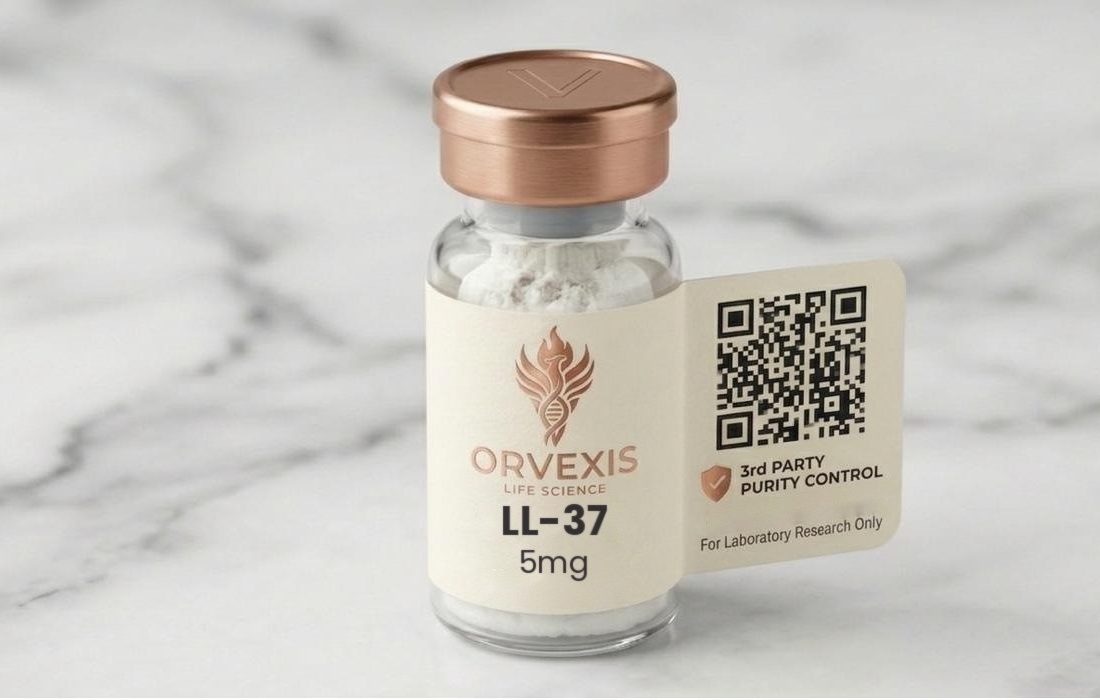
Every vial carries this batch's QR. It opens the lab's own report on the lab's servers, verify this batch yourself, no account needed.
Showing the three most recent. Every earlier batch keeps its own report page, so a vial bought months ago can still be checked. See all batches of this product →
LL-37
5 mg lyophilized powder in a sealed glass vial.
- EU warehouseno customs, tracked to your door
- Card paymentregistered seller · company details
- Sequence
- Leu-Leu-Gly-Asp-Phe-Phe-Arg-Lys-Ser-Lys-Glu-Lys-Ile-Gly-Lys-Glu-Phe-Lys-Arg-Ile-Val-Gln-Arg-Ile-Lys-Asp-Phe-Leu-Arg-Asn-Leu-Val-Pro-Arg-Thr-Glu-Ser
- CAS number
- 154947-66-7
- Molecular weight
- 4493.3 g/mol
- Counter-ion
- Stated on the certificate of analysis
- Contents
- LL-37 · 5 mg per vial
- Form
- Lyophilized powder, sealed under inert gas
- Storage
- 2–8 °C sealed, protected from light
- Documentation
- Certificate of Analysis per batch, linked via QR
- Delivery
- Ships from our warehouse in Poland within 1–3 working days, tracked, no customs within the EU. Typically 3–5 working days; shipping €9.00, free from €150.
What LL-37 is
LL-37 is the only cathelicidin-family antimicrobial peptide found in humans. It is a linear peptide of 37 amino acids, named for its two N-terminal leucines, and is released from the C-terminus of the precursor protein hCAP18 (encoded by the CAMP gene) when neutrophil proteinase 3 or skin kallikreins cleave the precursor. The peptide is cationic and amphipathic and forms an alpha helix on contact with membranes. It occurs in neutrophil granules, epithelial surfaces, sweat and other secretions, and its production is regulated by vitamin D. It is supplied here as a lyophilized (freeze-dried) powder for laboratory research.
What the research examines
Antimicrobial activity. In vitro studies measured the concentrations at which LL-37 kills Gram-positive and Gram-negative bacteria, fungi and some enveloped viruses, and used biophysical methods to characterise how the peptide inserts into and disrupts microbial membranes. Work with Pseudomonas aeruginosa reported reduced biofilm formation at concentrations below those that kill free-living cells, together with changes in bacterial gene expression and motility.
Immune signalling. Cell-culture and mouse studies examined LL-37 as a signalling molecule: chemotaxis of neutrophils, monocytes and T cells through the formyl peptide receptor FPR2, neutralisation of bacterial lipopolysaccharide, and modulation of cytokine output after Toll-like receptor stimulation. A 2007 paper in Nature reported that LL-37 forms complexes with self-DNA that activate plasmacytoid dendritic cells, a mechanism since studied in psoriasis and other autoimmune conditions.
Wound models. Studies of human skin reported LL-37 in the epithelium of healing wounds but not at chronic ulcer margins, and cell and animal experiments measured keratinocyte migration and re-epithelialisation. A phase IIb randomised placebo-controlled trial of ropocamptide, a synthetic LL-37, enrolled 148 people with venous leg ulcers and measured complete healing; the primary endpoint was not met overall, with a post-hoc signal in ulcers of ten square centimetres or larger.
Inflammatory disease. Because LL-37 concentrations are altered in psoriasis, rosacea, atopic dermatitis, lupus and chronic lung disease, many studies measured the peptide in tissue and blood samples and examined its interactions with nucleic acids, immune complexes and neutrophil extracellular traps in cell culture, to characterise its contribution to the inflammation observed in these conditions.
LL-37 has a large preclinical literature and a modest clinical one. The synthetic form, ropocamptide, was studied in phase I/II and phase IIb trials for venous leg ulcers between 2014 and 2021; the phase IIb trial did not meet its primary endpoint in the full population and no approval has followed. LL-37 is not an approved medicine, and this page makes no claims about effects in humans.
Selected literature
- Dürr UHN, et al. Biochimica et Biophysica Acta (BBA) - Biomembranes, 2006, review of structure and antimicrobial mechanism. doi:10.1016/j.bbamem.2006.03.030
- Sørensen OE, et al. Blood, 2001, primary biochemical study of precursor processing. doi:10.1182/blood.V97.12.3951
- Lande R, et al. Nature, 2007, cell-culture and patient-sample study of LL-37 in psoriasis. doi:10.1038/nature06116
- Overhage J, et al. Infection and Immunity, 2008, in vitro biofilm study. doi:10.1128/IAI.00318-08
- Mahlapuu M, et al. Wound Repair and Regeneration, 2021, phase IIb trial, 148 participants. doi:10.1111/wrr.12977
Every reference is listed with its DOI in the research library.
Handling in the laboratory
Store sealed at 2–8 °C for routine use or frozen for long-term storage, protected from light and moisture. Let the vial reach room temperature before opening. See Storage and handling of lyophilized research peptides.
New to research peptides?
What is a research peptide?
A short chain of amino acids produced synthetically for laboratory investigation. Research peptides are sold as chemical reagents to study biological mechanisms; they are not medicines, foods or supplements and are not for human use.
What does "lyophilized" mean?
Freeze-dried. The peptide is supplied as a dry powder, which keeps it stable in storage. It is dissolved in the laboratory before use in an experiment.
How do I verify a batch?
Scan the QR on the vial, or open "Verify a batch" and enter the batch number. The report opens on the independent laboratory's own website, we cannot edit it.
What does the purity figure mean?
The share of the vial's peptide content that is the intended sequence, measured by HPLC. Identity is confirmed separately by mass spectrometry, so both "what" and "how pure" are tested.
How should it be stored?
Sealed vials at 2–8 °C, protected from light. Our storage guide covers handling of opened vials.