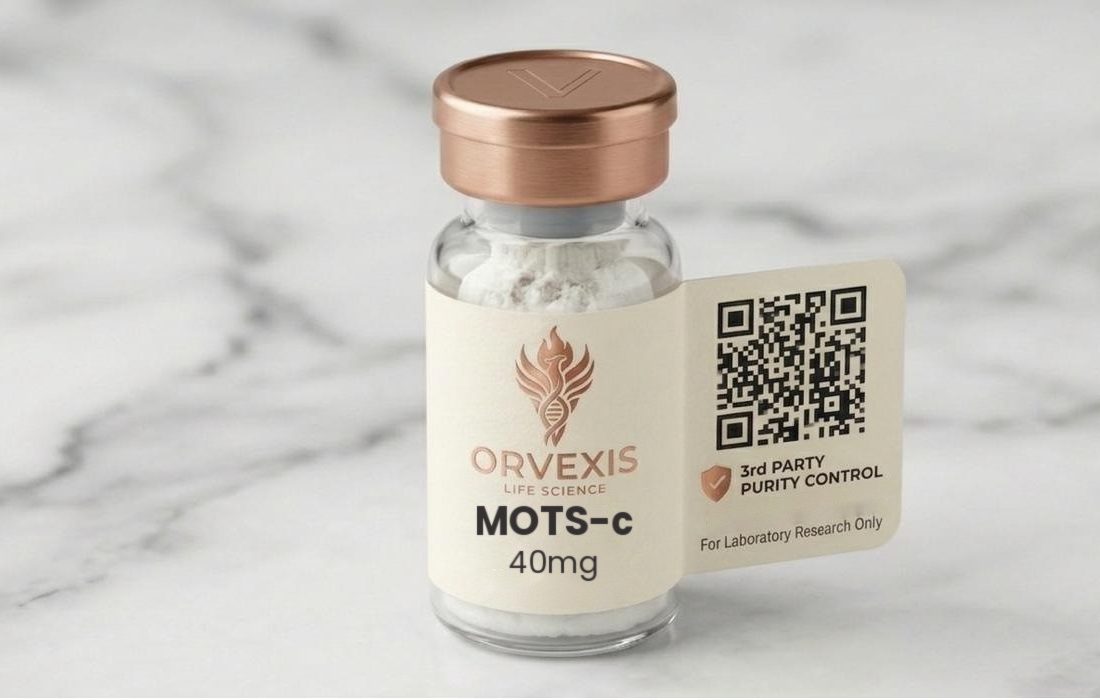
Every vial carries this batch's QR. It opens the lab's own report on the lab's servers, verify this batch yourself, no account needed.
Showing the three most recent. Every earlier batch keeps its own report page, so a vial bought months ago can still be checked. See all batches of this product →
MOTS-c
40 mg lyophilized powder in a sealed glass vial.
- EU warehouseno customs, tracked to your door
- Card paymentregistered seller · company details
- Sequence
- Met-Arg-Trp-Gln-Glu-Met-Gly-Tyr-Ile-Phe-Tyr-Pro-Arg-Lys-Leu-Arg
- CAS number
- 1627580-64-6
- Molecular weight
- 2174.6 g/mol
- Counter-ion
- Stated on the certificate of analysis
- Contents
- MOTS-c · 40 mg per vial
- Form
- Lyophilized powder, sealed under inert gas
- Storage
- 2–8 °C sealed, protected from light
- Documentation
- Certificate of Analysis per batch, linked via QR
- Delivery
- Ships from our warehouse in Poland within 1–3 working days, tracked, no customs within the EU. Typically 3–5 working days; shipping €9.00, free from €150.
What MOTS-c is
MOTS-c (mitochondrial open reading frame of the 12S rRNA type-c) is a peptide of 16 amino acids encoded by a short open reading frame inside the mitochondrial 12S ribosomal RNA gene, one of a small family of mitochondrial-derived peptides. It was first described in 2015, and the endogenous peptide has since been measured in human plasma and skeletal muscle. Its sequence begins with methionine and carries several basic residues. The material sold here is synthetic and supplied as a lyophilized (freeze-dried) powder for laboratory research.
What the research examines
Metabolic regulation. The 2015 discovery paper studied MOTS-c in cultured cells and in mice, reporting that it acted on the folate–methionine cycle and on AMPK signalling. In mice fed a high-fat diet, the peptide was reported to limit fat accumulation and to alter glucose tolerance and insulin sensitivity, measured by tolerance tests and hyperinsulinaemic clamp studies.
Exercise and skeletal muscle. A 2021 study measured endogenous MOTS-c in muscle biopsies and plasma from ten sedentary young men before, during and after a bout of exercise, reporting increases in both. In mice, the same work examined treadmill running, grip strength and gait in young, middle-aged and old animals, and compared skeletal-muscle metabolomic profiles between treated and control groups.
Nuclear signalling. Cell-culture studies examined where MOTS-c localises inside the cell. Under metabolic stress, including glucose restriction and oxidative challenge, the peptide was observed to move from mitochondria to the nucleus, where it associated with stress-responsive transcription factors and altered the expression of antioxidant-response genes.
Human genetic variation. Population studies examined a naturally occurring mitochondrial DNA variant (m.1382A>C) that replaces lysine 14 of MOTS-c with glutamine. In Japanese cohorts the variant was associated with type 2 diabetes in men, and cell and mouse experiments compared the activity of the variant peptide with that of the common form.
Almost all MOTS-c research is preclinical, in cell culture and mice, alongside observational measurements of the endogenous peptide in human blood and muscle. No clinical trial of MOTS-c itself has been published; a chemically modified analogue (CB4211) was tested in an early-phase trial by a biotechnology company. MOTS-c is not an approved medicine, and this page makes no claims about effects in humans.
Selected literature
- Lee C, et al. Cell Metabolism, 2015, discovery paper; cell culture and mouse models. doi:10.1016/j.cmet.2015.02.009
- Reynolds JC, et al. Nature Communications, 2021, mouse models plus human muscle and plasma samples (N=10). doi:10.1038/s41467-020-20790-0
- Kim KH, et al. Cell Metabolism, 2018, cell-culture mechanism study. doi:10.1016/j.cmet.2018.06.008
- Zempo H, et al. Aging, 2021, human genetic association plus cell and mouse work. doi:10.18632/aging.202529
- Mohtashami Z, et al. International Journal of Molecular Sciences, 2022, review. doi:10.3390/ijms231911991
Every reference is listed with its DOI in the research library.
Handling in the laboratory
Store sealed at 2–8 °C for routine use or frozen for long-term storage, protected from light and moisture. Let the vial reach room temperature before opening. See Storage and handling of lyophilized research peptides.
New to research peptides?
What is a research peptide?
A short chain of amino acids produced synthetically for laboratory investigation. Research peptides are sold as chemical reagents to study biological mechanisms; they are not medicines, foods or supplements and are not for human use.
What does "lyophilized" mean?
Freeze-dried. The peptide is supplied as a dry powder, which keeps it stable in storage. It is dissolved in the laboratory before use in an experiment.
How do I verify a batch?
Scan the QR on the vial, or open "Verify a batch" and enter the batch number. The report opens on the independent laboratory's own website, we cannot edit it.
What does the purity figure mean?
The share of the vial's peptide content that is the intended sequence, measured by HPLC. Identity is confirmed separately by mass spectrometry, so both "what" and "how pure" are tested.
How should it be stored?
Sealed vials at 2–8 °C, protected from light. Our storage guide covers handling of opened vials.