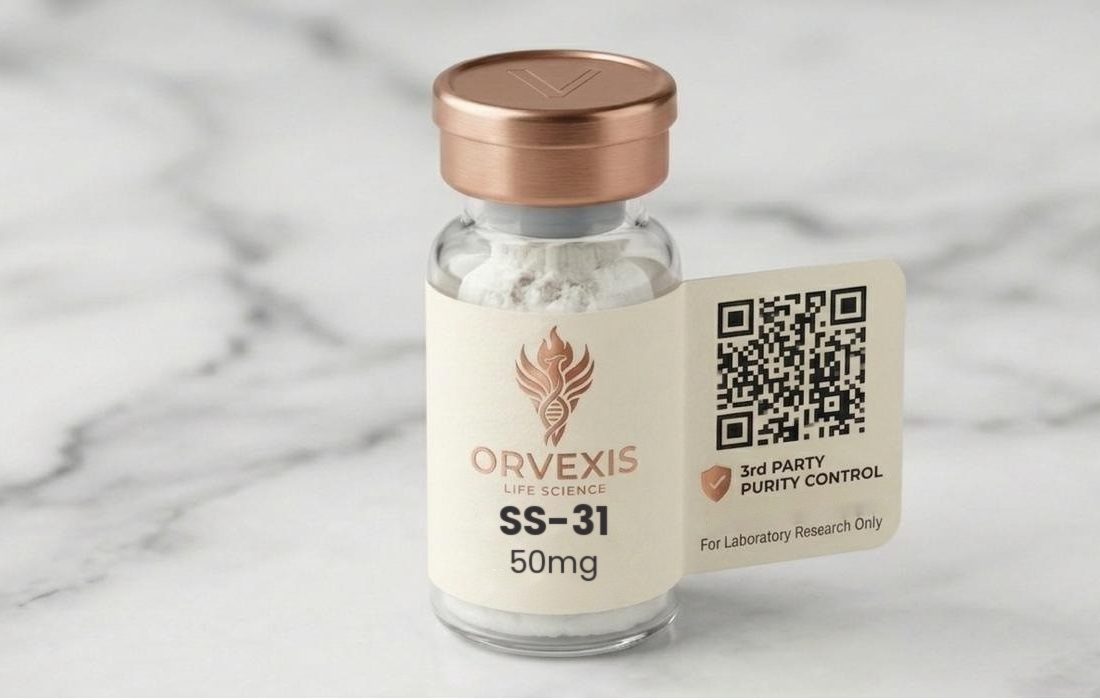
Every vial carries this batch's QR. It opens the lab's own report on the lab's servers, verify this batch yourself, no account needed.
Showing the three most recent. Every earlier batch keeps its own report page, so a vial bought months ago can still be checked. See all batches of this product →
SS-31
50 mg lyophilized powder in a sealed glass vial.
- EU warehouseno customs, tracked to your door
- Card paymentregistered seller · company details
- Sequence
- D-Arg-Dmt-Lys-Phe-NH2
- CAS number
- 736992-21-5
- Molecular weight
- 639.8 g/mol
- Counter-ion
- Stated on the certificate of analysis
- Contents
- SS-31 · 50 mg per vial
- Form
- Lyophilized powder, sealed under inert gas
- Storage
- 2–8 °C sealed, protected from light
- Documentation
- Certificate of Analysis per batch, linked via QR
- Delivery
- Ships from our warehouse in Poland within 1–3 working days, tracked, no customs within the EU. Typically 3–5 working days; shipping €9.00, free from €150.
What SS-31 is
SS-31 (elamipretide; also MTP-131 and Bendavia) is a synthetic tetrapeptide with the sequence D-Arg-Dmt-Lys-Phe-NH2, where Dmt is 2',6'-dimethyltyrosine. It belongs to the Szeto–Schiller family of aromatic-cationic peptides designed in the early 2000s, and it accumulates in the inner mitochondrial membrane, where it binds the phospholipid cardiolipin. Developed by Stealth BioTherapeutics, the molecule received accelerated approval from the US Food and Drug Administration in September 2025 as Forzinity (elamipretide hydrochloride) for Barth syndrome, a rare inherited disorder of cardiolipin metabolism. It is supplied here as a lyophilized (freeze-dried) powder for laboratory research.
What the research examines
Cardiolipin and bioenergetics. Biophysical and cell-free studies characterised the binding of SS-31 to cardiolipin and its influence on cytochrome c and electron transport. Work in isolated mitochondria and in a rat model of kidney ischaemia measured ATP synthesis, mitochondrial swelling and membrane potential, reporting preserved cristae structure and faster restoration of ATP after ischaemia in treated animals.
Ischaemia–reperfusion injury. Early studies exposed cultured cells to oxidative stress and used rodent models of heart, brain and kidney ischaemia–reperfusion, measuring infarct size, lipid peroxidation and cell death. A phase 2 trial in 297 people with ST-elevation myocardial infarction undergoing primary angioplasty compared infarct size, measured by creatine-kinase release, between elamipretide and placebo, and reported no difference.
Heart failure. A randomised, placebo-controlled trial in 71 adults with heart failure and reduced ejection fraction measured left-ventricular volumes by echocardiography after a single administration, reporting smaller end-systolic and end-diastolic volumes in one treatment group than with placebo. A later four-week phase 2 trial measured the same volumes and did not reproduce a difference from placebo.
Mitochondrial disease trials. A six-month phase 3 trial (MMPOWER-3) in 218 adults with primary mitochondrial myopathy measured six-minute walk distance and a fatigue score and reported no difference from placebo on either primary endpoint. In Barth syndrome, a crossover trial in 12 participants also did not meet its primary endpoints, while its open-label extension reported gains in walk distance and knee-extensor strength, the measure on which the accelerated approval rests.
SS-31 has been studied in randomised trials in myocardial infarction, heart failure, mitochondrial myopathy and Barth syndrome, several of which did not meet their primary endpoints. The same molecule became an approved medicine in the United States in September 2025 as Forzinity (elamipretide hydrochloride), under accelerated approval for Barth syndrome. The research-grade material sold here is not a medicine, and this page makes no claims about effects in humans.
Selected literature
- Zhao K, et al. Journal of Biological Chemistry, 2004, original cell and isolated-heart study. doi:10.1074/jbc.M402999200
- Birk AV, et al. Journal of the American Society of Nephrology, 2013, mechanism study, isolated mitochondria and rat kidney model. doi:10.1681/ASN.2012121216
- Daubert MA, et al. Circulation: Heart Failure, 2017, randomised trial in heart failure, N=71. doi:10.1161/CIRCHEARTFAILURE.117.004389
- Thompson WR, et al. Genetics in Medicine, 2021, phase 2/3 crossover trial in Barth syndrome, N=12. doi:10.1038/s41436-020-01006-8
- Karaa A, et al. Neurology, 2023, phase 3 trial (MMPOWER-3), N=218. doi:10.1212/WNL.0000000000207402
Every reference is listed with its DOI in the research library.
Handling in the laboratory
Store sealed at 2–8 °C for routine use or frozen for long-term storage, protected from light and moisture. Let the vial reach room temperature before opening. See Storage and handling of lyophilized research peptides.
New to research peptides?
What is a research peptide?
A short chain of amino acids produced synthetically for laboratory investigation. Research peptides are sold as chemical reagents to study biological mechanisms; they are not medicines, foods or supplements and are not for human use.
What does "lyophilized" mean?
Freeze-dried. The peptide is supplied as a dry powder, which keeps it stable in storage. It is dissolved in the laboratory before use in an experiment.
How do I verify a batch?
Scan the QR on the vial, or open "Verify a batch" and enter the batch number. The report opens on the independent laboratory's own website, we cannot edit it.
What does the purity figure mean?
The share of the vial's peptide content that is the intended sequence, measured by HPLC. Identity is confirmed separately by mass spectrometry, so both "what" and "how pure" are tested.
How should it be stored?
Sealed vials at 2–8 °C, protected from light. Our storage guide covers handling of opened vials.