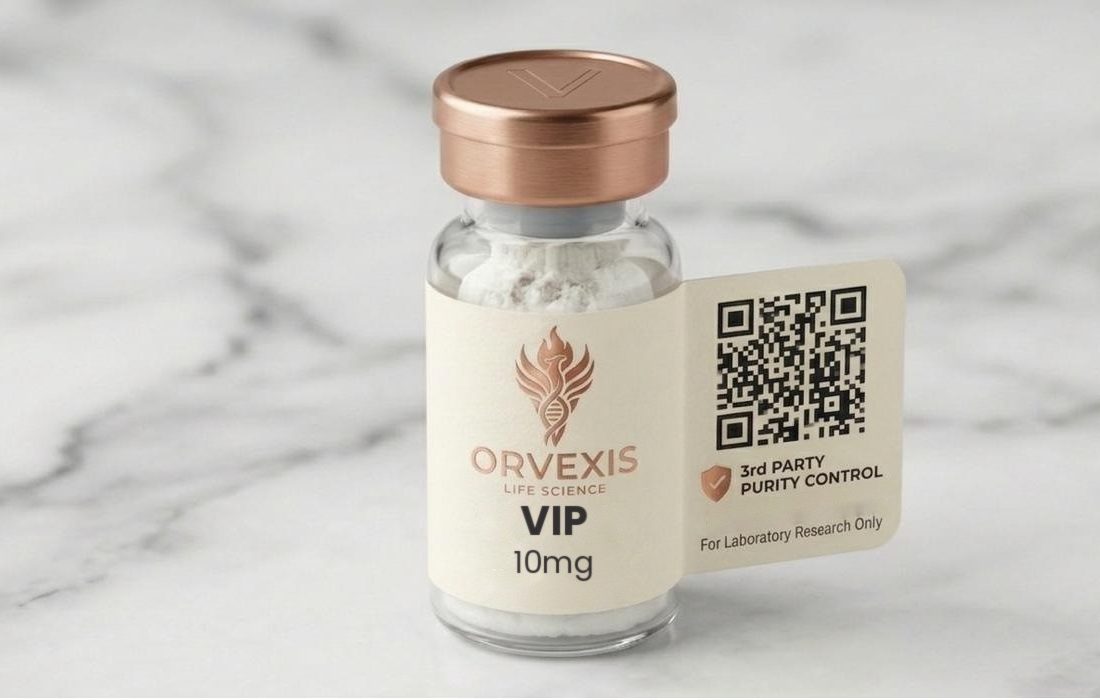
Every vial carries this batch's QR. It opens the lab's own report on the lab's servers, verify this batch yourself, no account needed.
Showing the three most recent. Every earlier batch keeps its own report page, so a vial bought months ago can still be checked. See all batches of this product →
VIP
10 mg lyophilized powder in a sealed glass vial.
- EU warehouseno customs, tracked to your door
- Card paymentregistered seller · company details
- Sequence
- His-Ser-Asp-Ala-Val-Phe-Thr-Asp-Asn-Tyr-Thr-Arg-Leu-Arg-Lys-Gln-Met-Ala-Val-Lys-Lys-Tyr-Leu-Asn-Ser-Ile-Leu-Asn-NH2
- CAS number
- 40077-57-4
- Molecular weight
- 3326.8 g/mol
- Counter-ion
- Stated on the certificate of analysis
- Contents
- VIP · 10 mg per vial
- Form
- Lyophilized powder, sealed under inert gas
- Storage
- 2–8 °C sealed, protected from light
- Documentation
- Certificate of Analysis per batch, linked via QR
- Delivery
- Ships from our warehouse in Poland within 1–3 working days, tracked, no customs within the EU. Typically 3–5 working days; shipping €9.00, free from €150.
What VIP is
VIP (vasoactive intestinal peptide) is a 28-residue peptide hormone of the secretin-glucagon family, isolated from porcine small intestine by Said and Mutt in 1970. It is produced by neurons of the gut, lung, brain and immune tissues, acts through the VPAC1 and VPAC2 receptors, and is characterised in the literature as a neuropeptide with vasodilator, secretory and immune-regulatory roles. The synthetic peptide carries the international non-proprietary name aviptadil and has a long regulatory history, including an approved combination product in some countries and a large COVID-19 trial programme. It is supplied here as a lyophilized (freeze-dried) powder for laboratory research.
What the research examines
Receptor pharmacology. Cell and tissue studies characterised the binding of VIP to the VPAC1 and VPAC2 receptors, both G-protein-coupled receptors signalling through cyclic AMP, and mapped receptor distribution in lung, gut, blood vessels and immune cells. This work underlies the IUPHAR classification of the VIP and PACAP receptor family and the design of receptor-selective analogues.
Immune regulation. Studies in cultured macrophages, T cells and dendritic cells, and in mouse models of inflammatory and autoimmune disease, measured cytokine production, regulatory T-cell induction and disease scores after exposure to VIP, and reported lower output of inflammatory cytokines in several of these models.
Pulmonary conditions. Pilot studies examined aviptadil in people with primary pulmonary hypertension (n=8, reported in 2003) and pulmonary sarcoidosis (n=20, reported in 2010), measuring pulmonary haemodynamics, exercise capacity, and cytokine production and regulatory T cells in bronchoalveolar lavage. These were small, uncontrolled studies and were not followed by an authorised product.
COVID-19 respiratory failure. Two randomised, placebo-controlled trials examined aviptadil in people with COVID-19-associated respiratory failure. A 196-participant industry trial (2:1 randomisation) measured survival free of respiratory failure at day 60 and reported no significant difference on that primary endpoint; the NIH-sponsored TESICO trial (461 analysed) measured a six-category ordinal outcome at day 90 and reported no significant difference from placebo.
Aviptadil combined with phentolamine is an approved medicine for erectile dysfunction in some countries (Invicorp, approved in Denmark in 1998; UK marketing authorisation 2015). Its COVID-19 programme did not meet its primary endpoints in placebo-controlled trials and a US emergency-use application was not granted, although India granted emergency-use approval in 2022. The research-grade material sold here is not a medicine, and this page makes no claims about effects in humans.
Selected literature
- Said SI, Mutt V Science, 1970, original isolation. doi:10.1126/science.169.3951.1217
- Delgado M, Ganea D Amino Acids, 2011, review of immune studies. doi:10.1007/s00726-011-1184-8
- Petkov V, et al. Journal of Clinical Investigation, 2003, uncontrolled pilot study, 8 participants. doi:10.1172/JCI17500
- Prasse A, et al. American Journal of Respiratory and Critical Care Medicine, 2010, uncontrolled pilot study, 20 participants. doi:10.1164/rccm.200909-1451OC
- Brown SM, et al. The Lancet Respiratory Medicine, 2023, phase 3 randomised placebo-controlled trial. doi:10.1016/S2213-2600(23)00147-9
Every reference is listed with its DOI in the research library.
Handling in the laboratory
Store sealed at 2–8 °C for routine use or frozen for long-term storage, protected from light and moisture. Let the vial reach room temperature before opening. See Storage and handling of lyophilized research peptides.
New to research peptides?
What is a research peptide?
A short chain of amino acids produced synthetically for laboratory investigation. Research peptides are sold as chemical reagents to study biological mechanisms; they are not medicines, foods or supplements and are not for human use.
What does "lyophilized" mean?
Freeze-dried. The peptide is supplied as a dry powder, which keeps it stable in storage. It is dissolved in the laboratory before use in an experiment.
How do I verify a batch?
Scan the QR on the vial, or open "Verify a batch" and enter the batch number. The report opens on the independent laboratory's own website, we cannot edit it.
What does the purity figure mean?
The share of the vial's peptide content that is the intended sequence, measured by HPLC. Identity is confirmed separately by mass spectrometry, so both "what" and "how pure" are tested.
How should it be stored?
Sealed vials at 2–8 °C, protected from light. Our storage guide covers handling of opened vials.